Tristram's crushed nose
The Life and Opinions of Tristram Shandy, GentlemanTristram's crushed nose is the consequence of his difficult birth and one of the novel’s most consequential accidents: a forceps injury that gives bodily form to the Shandy family’s fears about childbirth, intellect, and chance. The injury is not treated as an isolated medical mishap. It follows a dispute over who would attend the delivery, becomes the occasion for Walter Shandy’s collapse into grief, and is made by the narrator to stand for the many small accidents that can frustrate a family’s plans and alter a life.
Identity and Background
The injury occurs at Tristram’s birth, when the edge of the forceps breaks down the bridge of his nose. The account elsewhere describes his nose as crushed flat against his face. Susannah reports the damage, and the image is made painfully concrete when she improvises a false bridge from cotton and a thin piece of whalebone taken from her stays, trying to raise the flattened nose.
The episode is foreshadowed by Walter Shandy’s consuming interest in the circumstances of conception and birth. He believes that a child’s bodily formation can shape the delicate structure underlying wit, memory, fancy, and eloquence. He also reads medical writing about the pressure exerted on an infant’s head during labor, and imagines that birth can deform the brain and injure the foundations of understanding. The nose injury therefore arrives in a household already prepared to see birth as a decisive and perilous encounter between the body and the mind.
The Dispute over the Birth
The injury’s circumstances are bound to a conflict over medical authority and maternal choice. After the pregnancy is established, Tristram’s mother settles on the parish midwife, an older practitioner with nearly twenty years’ experience and, by the narrator’s account, no accident fairly attributable to her. A scientific operator is also available nearby, and has published a five-shilling book on midwifery, but she is determined to entrust her life and the child’s to the midwife alone.
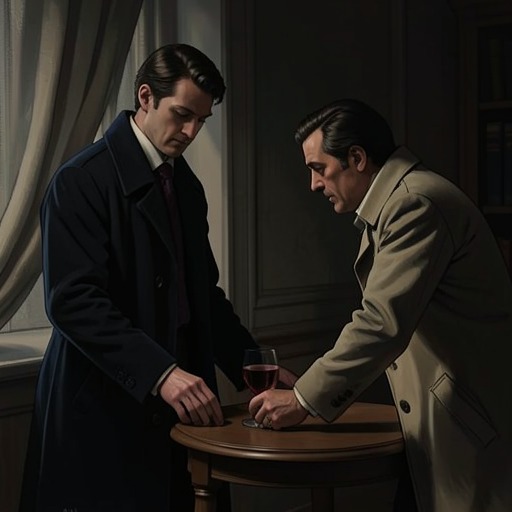
Walter opposes that choice. He wants the male operator to attend and argues persistently, invoking private concerns about the delivery as well as his political theory that any mishap would strengthen the power of women in household government. His wife insists on her right to choose her own attendant. The dispute ends in a compromise: the old midwife will deliver the child, while the operator is permitted to drink a bottle of wine with Walter and Toby Shandy in the back parlour, for which he is to receive five guineas. The forceps injury gives this elaborate negotiation an ironic result: the desired professional presence is arranged, but the child’s nose is damaged in the very process Walter has invested with such consequence.
Walter Shandy’s Reaction
The news reaches Walter through Toby and Corporal Trim. When Walter objects to the damaged drawbridge in Toby’s miniature fortifications, Trim turns the image abruptly toward the family’s calamity: the child’s nose, he says, has been crushed flat by the operator’s instruments, and Susannah is trying to construct a false bridge for it. Walter immediately asks his brother to lead him to his room.
The narrator marks this moment as the culmination of a gathering storm of small troubles for his father. Yet the injury, serious as it is, does not by itself account for the extravagance of Walter’s affliction. The text emphasizes both his painstaking investment in begetting a child and the disproportionate, un-Christian manner in which he gives himself over to grief. He is left on the bed for half an hour, with Toby sitting beside him in an old fringed chair. The stillness of that tableau contrasts with the busy argument and elaborate theories that have surrounded the birth.
A Body Made into an Argument
Walter’s distress draws force from his theory that the way a child enters the world may damage the intellectual constitution. In his reading about childbirth, he encounters the claim that labor’s pressure can compress an infant’s pliable skull. The account gives that force an astonishing numerical scale: an average pressure equivalent to 470 pounds acting perpendicularly on the head. Walter imagines that such compression would injure the cerebellum, which he takes to be the immediate seat of understanding, and sees the mind’s confusion as the consequence of a brain’s being forced into the wrong shape.
That theory makes Tristram’s visible injury legible to Walter as more than a broken bridge of cartilage. A damaged nose becomes evidence in a larger, speculative case about the vulnerability of human understanding and the hazards of obstetric practice. The novel does not establish Walter’s medical reasoning as reliable; it shows how learned reading, anatomical speculation, and parental anxiety combine to magnify an injury into a crisis of intellect and destiny.
Accident, Motif, and Narrative Consequence
The narrator places the crushed nose within a wider pattern of small accidents that repeatedly thwart Tristram. Looking back at the tangled delay caused by Obadiah’s tying up of the medical bag and instruments, he imagines that, had Nature and the bag been in a race, his mother would have been delivered sooner than the bag could be unknotted. In that counterfactual version, Tristram’s affairs might not have been depressed by the depression of his nose, and the fortunes of the family might not have been so vexatiously abandoned. The injury thus becomes part of a chain of missed chances: not only a bodily consequence, but a sign of how contingency keeps interrupting intention.
The novel’s handling of the episode also makes its material form part of the story. The narrator pauses over blank and marbled pages and over chapters that are missing, broken, or unexpectedly divided. Such interruptions do not repair or explain the injury; they echo a narrative world in which continuity is continually disrupted. Tristram’s nose remains the sharpest bodily instance of that pattern: an accident at the threshold of life that Walter interprets as damage to the mind, while the narrator turns it into a recurring figure for the unpredictable course of a life and of the telling that attempts to contain it.